
What Is the Monthly Payment on a $300,000 Mortgage?
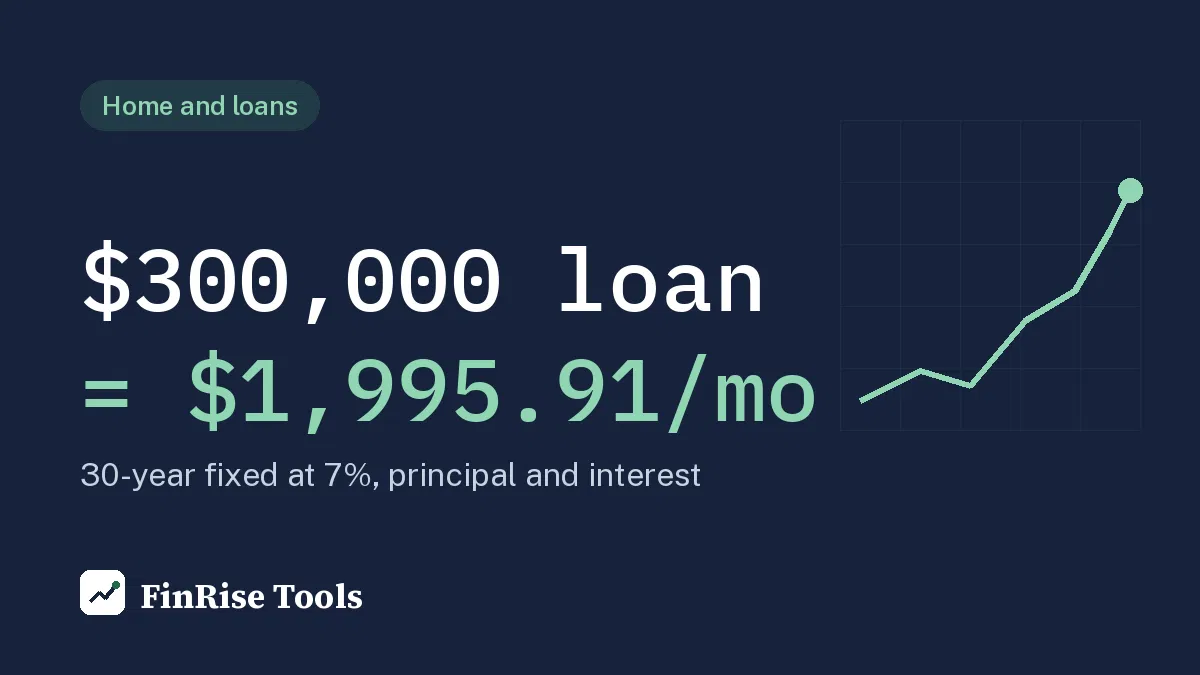
The monthly payment on a $300,000 mortgage is $1,995.91 for principal and interest at a 7% fixed rate over 30 years. Add typical property tax and homeowners insurance and the total comes to about $2,490 a month. This guide shows the payment at different rates, the 15-year option, the income you may need and how extra payments cut your interest.
How the payment is calculated
Fixed-rate mortgages use a standard formula that spreads the loan into equal monthly payments. Each payment covers that month's interest first, and the rest pays down the balance.
In the first month, interest on $300,000 at 7% is $1,750.00, so only $245.91 of that first payment reduces the balance. The split slowly shifts. On this loan, the principal part of the payment does not overtake the interest part until payment number 242, a little over 20 years in.
$300,000 mortgage payment at different rates
Your interest rate has the biggest effect on the payment. Here is principal and interest on a $300,000 loan for 30-year and 15-year terms.
| Rate | 30-year payment | 30-year total interest | 15-year payment |
|---|---|---|---|
| 6.0% | $1,798.65 | $347,515 | $2,531.57 |
| 6.5% | $1,896.20 | $382,637 | $2,613.32 |
| 7.0% | $1,995.91 | $418,524 | $2,696.48 |
| 7.5% | $2,097.64 | $455,155 | $2,781.04 |
| 8.0% | $2,201.29 | $492,471 | $2,866.96 |
Every half-point costs about $100 a month on a 30-year loan of this size, and roughly $36,000 in total interest over the life of the loan. For context, Freddie Mac's weekly survey on September 24, 2026 put the average 30-year fixed rate at 7.03% and the 15-year rate at 6.42%.
The full monthly cost: PITI
Most lenders collect property tax and homeowners insurance with your mortgage payment and pay those bills from an escrow account. Together with principal and interest, this is known as PITI. Here is an example for a $375,000 home bought with 20% down, which leaves a $300,000 loan:
- Principal and interest (30 years at 7%)$1,995.91
- Property tax: $4,125 a year ÷ 12$343.75
- Homeowners insurance: $1,800 a year ÷ 12$150.00
- Total monthly payment$2,489.66
Property taxes vary widely by state and county, and insurance costs have been rising in many areas, so check local figures before you budget. Two other costs may apply:
- Private mortgage insurance (PMI). With less than 20% down on a conventional loan, lenders usually require PMI. Its cost depends mainly on your credit score and down payment. At a rate of 0.5% a year, PMI on a $300,000 loan would add $125 a month until it is removed.
- HOA dues. Condos and many planned communities charge monthly or yearly association fees, which lenders also count when deciding how much you can borrow.
The Mortgage Calculator lets you enter your own tax, insurance, PMI and HOA figures to see the full payment.
How much income do you need for a $300,000 mortgage?
A long-standing rule of thumb is the 28/36 guideline: keep housing costs at or below 28% of your gross monthly income, and all debt payments, including housing, at or below 36%.
- Total housing payment (PITI example above)$2,489.66
- Monthly income for 28%: $2,489.66 ÷ 0.28$8,891.64
- Yearly income needed~$106,700
If you also have $400 a month in other debt payments, such as a car loan, the 36% test points to about $96,300 a year, so the 28% test is the one that sets the bar in this example. These are guidelines, not hard rules. Many lenders approve higher debt-to-income ratios for borrowers with strong credit and savings, and a lower rate, a bigger down payment or lower taxes all reduce the income you need.
If you are paid by the hour, the Hourly to Salary Calculator converts your wage to a yearly figure you can compare with these numbers.
15-year vs. 30-year on $300,000
A 15-year loan usually comes with a lower rate. At 6.4%, the payment is $2,596.86 a month, about $601 more than the 30-year loan at 7%. Total interest falls from about $418,500 to about $167,400, a difference of roughly $251,000, and the house is paid off 15 years sooner.
The trade-off is flexibility. The 30-year loan's lower required payment leaves more room each month for emergencies, retirement savings and other goals. Some borrowers take the 30-year loan and add extra principal when they can, which keeps the lower required payment while still cutting interest.
What extra payments do on a $300,000 loan
Any amount you pay above the scheduled payment goes straight to principal, which lowers the interest charged every month after that. On a 30-year loan at 7%:
| Extra each month | Interest saved | Paid off sooner by |
|---|---|---|
| $100 | $69,337 | 4 years, 2 months |
| $200 | $116,638 | 7 years, 1 month |
| $500 | $200,233 | 12 years, 8 months |
Before you prepay, check that your loan has no prepayment penalty, make sure your lender applies the extra amount to principal, and keep an emergency fund in place. If you carry high-interest credit card debt, paying that off first usually saves more. See our guide on paying off $5,000 in credit card debt.
How the balance falls over time
Because early payments are mostly interest, the balance falls slowly at first and faster later. Here is the remaining balance on a $300,000, 30-year loan at 7% with no extra payments:
| After | Balance left | Paid off so far |
|---|---|---|
| 5 years | $282,395 | 6% |
| 10 years | $257,437 | 14% |
| 15 years | $222,056 | 26% |
| 20 years | $171,899 | 43% |
| 25 years | $100,795 | 66% |
| 30 years | $0 | 100% |
This matters if you expect to sell or refinance within a few years. After five years of payments, you would still owe about 94% of the original loan, so most of your equity at that point would come from your down payment and any rise in the home's value. If rates fall later, the Refinance Break-Even Calculator shows how long it would take for a refinance to pay for its closing costs.
Ways to lower the payment
- Raise your credit score before applying. Paying down card balances and paying every bill on time can move you into a better rate tier.
- Compare at least three lenders. Ask each for a Loan Estimate on the same day so the rates and fees are easy to compare side by side.
- Increase your down payment. Every $10,000 less borrowed at 7% over 30 years lowers the payment by about $67 a month, and reaching 20% down avoids PMI on a conventional loan.
- Shop your insurance. Homeowners insurance quotes can vary a lot for similar coverage.
- Ask about tax exemptions. Many areas offer a homestead exemption that lowers property tax on a primary home.
Frequently asked questions
What is the monthly payment on a $300,000 mortgage?
At a 7% fixed rate over 30 years, principal and interest on a $300,000 mortgage is $1,995.91 a month. At 6% it is $1,798.65 and at 8% it is $2,201.29. Property tax, homeowners insurance and any mortgage insurance or HOA dues are added on top.
How much income do I need for a $300,000 mortgage?
Using the common guideline that housing costs should stay at or below 28% of gross income, a total payment of about $2,490 a month, including tax and insurance, points to a household income of roughly $106,700 a year at a 7% rate. Lenders look at your full debt picture, credit and savings, so the actual amount can differ.
How much interest will I pay on a $300,000 mortgage?
On a 30-year loan at 7%, total interest comes to about $418,500 if you make only the scheduled payments. A 15-year loan at 6.4% cuts total interest to about $167,400.
What is the payment on a $300,000 mortgage over 15 years?
At a 6.4% fixed rate over 15 years, principal and interest is $2,596.86 a month, about $601 more than a 30-year loan at 7%.
How can I lower the payment on a $300,000 mortgage?
The main levers are a lower interest rate, a longer loan term, a bigger down payment that reduces the loan amount, and lower property tax and insurance costs. Improving your credit score and comparing several lenders are the simplest ways to get a better rate.
Calculate your own payment
Enter your home price, down payment, rate, taxes and insurance to see your full monthly payment and amortization schedule.
Open the Mortgage CalculatorSources and how we calculated
Payments use the standard fixed-rate amortization formula with interest calculated monthly and rounded to the cent. Totals assume every payment is made on schedule for the full term. Average rates come from Freddie Mac's Primary Mortgage Market Survey. For help comparing loan offers, see the Consumer Financial Protection Bureau's Buying a House tools.
This guide is for educational purposes only and is not financial advice. Rates, taxes, insurance and lending rules change, and your actual loan terms will depend on your lender, credit and location. Review your Loan Estimate for official figures.