
How Long Does It Take to Pay Off $5,000 in Credit Card Debt?
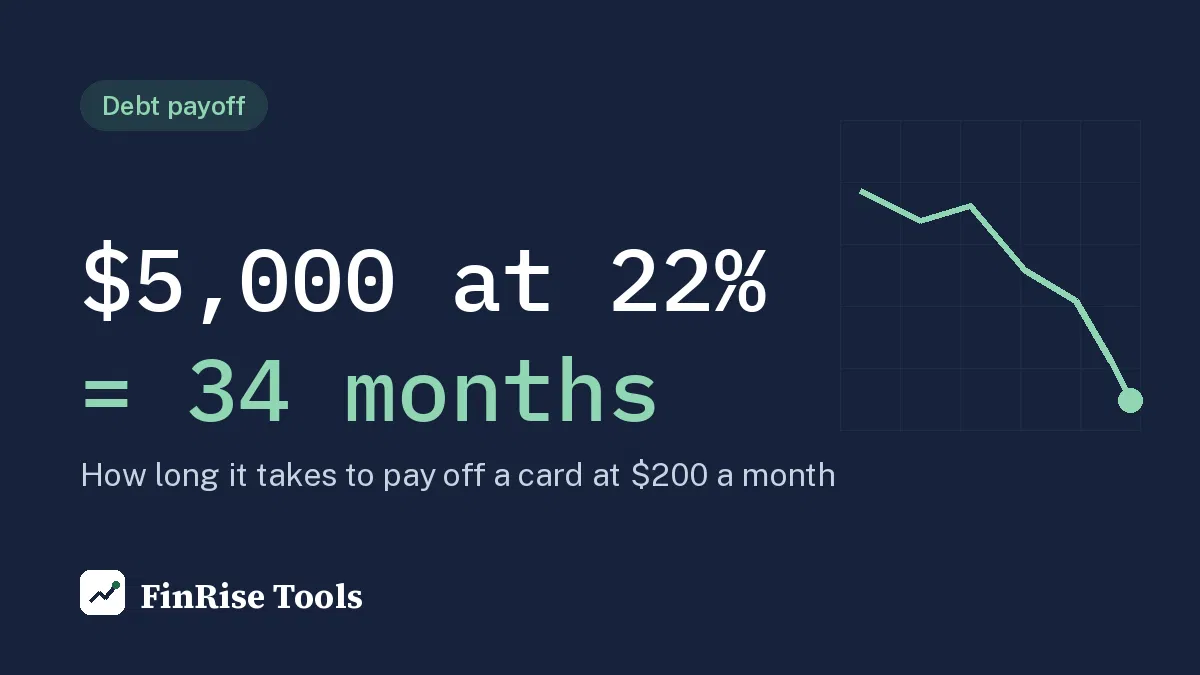
At a 22% APR, paying $200 a month clears a $5,000 credit card balance in 34 months and costs $1,749.90 in interest. Pay $300 a month and you are done in 21 months. This guide shows the full math, why minimum payments take so long, and practical ways to pay less interest.
How credit card interest works
Your card's annual percentage rate, or APR, is the yearly cost of carrying a balance. Each month, the card charges a slice of that rate on what you owe. Most issuers actually calculate interest daily, using your APR divided by 365, and add it up over the billing cycle. Dividing the APR by 12 gives a very close monthly estimate, and that is what we use here.
At 22% APR, the monthly rate is about 1.833%. On a $5,000 balance, that works out to $91.67 of interest in the first month. When you make a payment, that interest is covered first. Only the rest of your payment reduces the balance.
This is the single most important idea in paying off a card: the amount you pay above the monthly interest is what actually gets you out of debt. A $200 payment puts $108.33 toward the balance in month one. A $300 payment puts $208.33 toward it, almost twice as much, even though the payment is only 50% bigger.
Payoff time at different monthly payments
Here is how long a $5,000 balance at 22% APR takes to pay off, and how much interest you pay along the way, at five payment levels.
| Monthly payment | Time to pay off | Total interest |
|---|---|---|
| $110 | 99 months (8 yrs, 3 mo) | $5,848.99 |
| $150 | 52 months (4 yrs, 4 mo) | $2,798.09 |
| $200 | 34 months (2 yrs, 10 mo) | $1,749.90 |
| $300 | 21 months (1 yr, 9 mo) | $1,021.61 |
| $500 | 12 months (1 yr) | $574.44 |
Look at the jump from $110 to $150. An extra $40 a month cuts almost four years off the payoff and saves more than $3,000 in interest. That happens because $110 is only a little above the first month's interest, so the balance barely moves at first. Once your payment is comfortably above the interest, each extra dollar makes a smaller but still meaningful difference.
The minimum payment trap
Card issuers set a minimum payment you must make each month. The exact formula depends on your card agreement, but a common approach is 1% of the balance plus that month's interest, with a floor of around $25 to $35 once the balance gets small.
Using that kind of formula on a $5,000 balance at 22% APR, the first minimum payment would be about $141.67. That sounds manageable, and it is supposed to. The catch is that the minimum shrinks as your balance shrinks, so you never build up speed.
- First minimum payment$141.67
- Time to pay off, paying only the minimum197 months
- Total interest paid$7,673.08
That is more than 16 years, with more paid in interest than the original $5,000 balance. Compare it with simply paying a fixed $150 every month: 52 months and $2,798.09 in interest. The fixed payment starts out only a few dollars higher than the first minimum, yet it saves nearly $4,900 and more than 12 years.
Your statement shows this too
Under the Credit CARD Act of 2009, card statements must show how long it would take to pay off your balance if you made only the minimum payment, along with the monthly payment needed to pay it off in three years. It is worth checking that box on your next statement.
What it takes to be debt-free by a set date
If you would rather pick a finish line, work backward to the payment you need. For $5,000 at 22% APR:
- Paid off in 1 year (12 months)$467.97/mo
- Paid off in 2 years (24 months)$259.39/mo
- Paid off in 3 years (36 months)$190.95/mo
These come from the standard loan payment formula, where B is the balance, r is the monthly rate and n is the number of months: Payment = B × r ÷ (1 − (1 + r)−n). You do not need to do this by hand. The Credit Card Payoff Calculator has a "Pay off by a date" option that does it for you.
How much your APR matters
Your interest rate has a big effect on the total cost, even when the monthly payment stays the same. Here is the same $5,000 balance paid at $200 a month under different APRs:
| APR | Time to pay off | Total interest |
|---|---|---|
| 15% | 31 months | $1,032.67 |
| 18% | 32 months | $1,313.95 |
| 22% | 34 months | $1,749.90 |
| 25% | 36 months | $2,136.59 |
| 29% | 39 months | $2,762.41 |
Going from 29% to 15% saves more than $1,700 on the same payment. That is why lowering your rate, even for part of the payoff, can be worth the effort.
Three ways to pay less interest
1. A balance transfer card
Some cards offer a low or 0% introductory APR on balances you move over from another card. Most charge a transfer fee, often around 3% to 5% of the amount moved. With a 3% fee, moving $5,000 adds $150, for a new balance of $5,150. To clear that during an 18-month 0% period, you would need to pay about $286.11 a month. If any balance remains when the promotion ends, the regular APR applies to it, so plan your payments around the end date. Approval and terms depend on your credit.
2. A debt consolidation loan
A personal loan with a fixed rate replaces your card balance with a set monthly payment and a firm end date. For example, a $5,000 loan at 12% APR over 36 months costs about $166.07 a month and $978.58 in total interest. Paying the same balance off on a 22% card over 36 months takes $190.95 a month and $1,874.28 in interest. Check for origination fees, which some lenders subtract from the loan amount, and compare the full cost before you apply.
3. Lower your rate and stop the new charges
Calling your card issuer to ask for a lower APR costs nothing, and customers with a record of on-time payments sometimes get a reduction. At the same time, stop putting new purchases on the card while you pay it down. New charges quietly push your payoff date further away, even when you are paying more than the minimum.
A simple plan you can start this month
- Find your real numbers. Check your statement for the exact balance and APR.
- Pick a fixed payment you can keep. Choose an amount comfortably above the monthly interest, and keep paying it even as the minimum drops.
- Set up automatic payments. Automating the fixed amount means you never miss a due date or slip back to the minimum.
- Add windfalls. Put part of any tax refund, bonus or pay raise toward the balance.
- Review your rate. If your APR is high, compare a balance transfer or consolidation loan with your current path.
Frequently asked questions
How long does it take to pay off $5,000 on a credit card?
At a 22% APR with no new charges, paying $200 a month clears a $5,000 balance in 34 months, and $300 a month clears it in 21 months. Paying $500 a month gets it done in 12 months.
How much should I pay each month to clear $5,000 in two years?
At 22% APR, about $259.39 a month pays off $5,000 in 24 months. At a lower APR the payment needed is smaller, and at a higher APR it is larger.
Why is my balance going down so slowly?
Interest is charged before your payment reduces the balance. At 22% APR, about $91.67 of the first month's payment on a $5,000 balance goes to interest. If you pay close to that amount, very little is left over to lower what you owe.
Does paying off a credit card help my credit score?
Paying down a card lowers your credit utilization, which is the share of your available credit you are using. Lower utilization is generally better for your credit score, and paying on time every month matters most of all.
Should I close the card after I pay it off?
Not necessarily. Closing a card reduces your total available credit, which can raise your utilization on other cards. Many people keep a paid-off card open and use it lightly, or not at all, unless it charges an annual fee they do not want to pay.
Try your own balance
Enter your balance, APR and payment to see your payoff date, total interest and a year-by-year breakdown.
Open the Credit Card Payoff CalculatorHow we calculated these numbers
Every figure in this guide was calculated month by month: interest is found by applying the monthly rate (APR ÷ 12) to the balance, rounded to the cent, then the payment is subtracted. Minimum payment figures use 1% of the balance plus interest with a $35 floor, a common style of formula; your card's formula may differ. For more on your rights as a cardholder, see the Consumer Financial Protection Bureau's credit card resources.
This guide is for educational purposes only and is not financial advice. Results assume a fixed APR and no new charges or fees. Your card issuer may calculate interest and minimum payments differently.