
What Is the Car Payment on a $30,000 Loan?
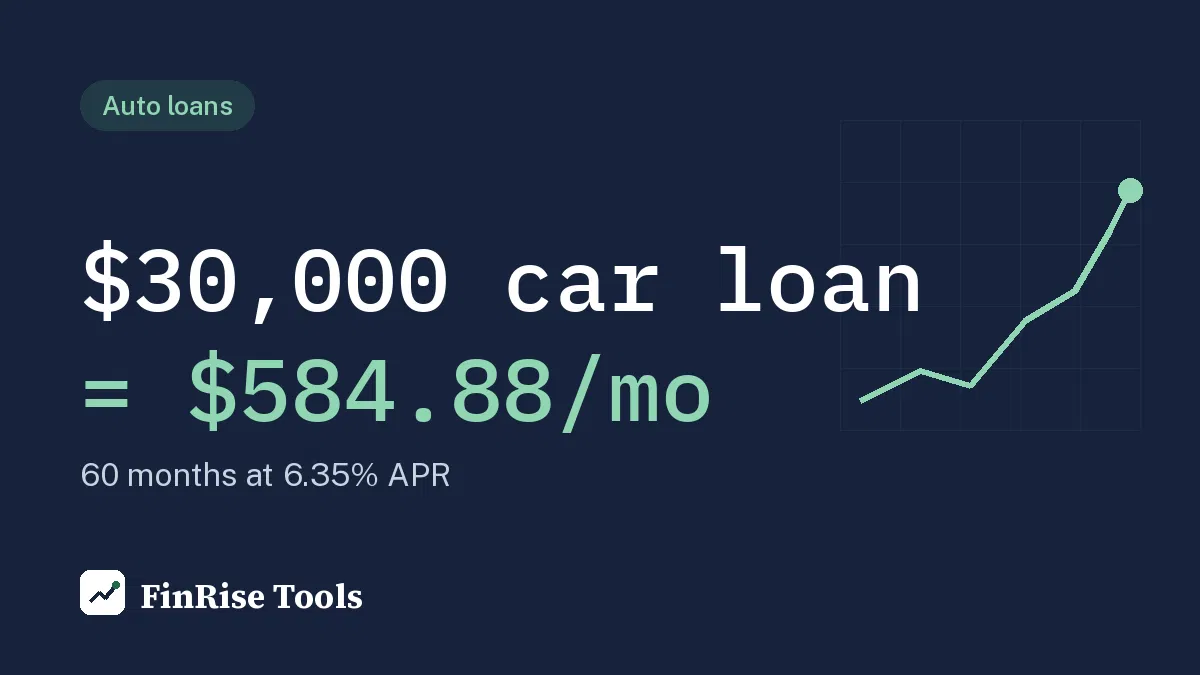
The monthly payment on a $30,000 car loan is $584.88 over 60 months at a 6.35% APR, the average rate for new cars in the second quarter of 2026. Over 72 months it drops to $502.16, and at the average used-car rate of 11.19% the 60-month payment rises to $655.12. This guide shows the payment at every common rate and term, and what the loan really costs.
How the payment is calculated
A car loan is repaid in equal monthly installments. Each payment covers that month's interest, and the rest pays down the balance. The standard formula is:
In the first month, interest is $158.75, so $426.13 of the payment goes toward the balance. As the balance falls, the interest part shrinks and more of each payment goes to principal.
Payment by interest rate and term
Monthly payment on $30,000 at different APRs and loan lengths:
| APR | 36 mo | 48 mo | 60 mo | 72 mo |
|---|---|---|---|---|
| 5.00% | $899.13 | $690.88 | $566.14 | $483.15 |
| 6.35% | $917.42 | $709.37 | $584.88 | $502.16 |
| 8.00% | $940.09 | $732.39 | $608.29 | $526.00 |
| 11.19% | $984.86 | $778.14 | $655.12 | $573.95 |
| 14.00% | $1,025.33 | $819.79 | $698.05 | $618.17 |
| 18.00% | $1,084.57 | $881.25 | $761.80 | $684.23 |
The spread between the best and worst rates is bigger than it looks. Over 60 months, the gap between 5% and 18% is about $196 a month, and about $11,700 more in interest over the life of the loan.
Total interest you will pay
Here is what the same $30,000 loan costs in interest alone:
| APR | 48 months | 60 months | 72 months |
|---|---|---|---|
| 5.00% | $3,162 | $3,968 | $4,787 |
| 6.35% | $4,050 | $5,093 | $6,155 |
| 11.19% | $7,351 | $9,307 | $11,324 |
| 18.00% | $12,300 | $15,708 | $19,265 |
At 18% over 72 months, interest adds up to almost two-thirds of the amount borrowed. That is why your credit score and the lender you choose can matter as much as the sticker price.
60 months vs. 72 months
Longer loans are now common. Experian's Q2 2026 data put the average new-car loan at 69.5 months and the average used-car loan at 67.9 months. At 6.35%, here is how 60 and 72 months compare on $30,000:
- 60-month payment$584.88
- 72-month payment$502.16
- Monthly savings with 72 months$82.72
- Extra interest with 72 months$1,062.62
The longer loan also keeps the balance higher. After one year, you would still owe $24,735 on the 60-month loan and $25,757 on the 72-month loan. Cars usually lose value fastest in their first few years, so a long loan with a small down payment makes it more likely you will owe more than the car is worth. That matters if the car is totaled or you want to trade it in early. Lenders often call this being "upside down" or having negative equity.
The real cost: price, tax and fees
A $30,000 loan does not always mean a $30,000 car. Sales tax, title and registration fees are often rolled into the loan, while a down payment or trade-in reduces it. For example, a $30,000 car with 6% sales tax and $800 in fees, and $5,000 down, leaves $27,600 to finance. At 6.35% over 60 months that is about $538 a month.
The Auto Loan Calculator handles all of these pieces, including trade-ins, and compares every term side by side.
New vs. used: same loan, different cost
Used-car loans usually carry higher rates than new-car loans because the car is worth less as collateral and is more likely to need repairs. In Experian's Q2 2026 data, the gap was almost five percentage points: 6.35% for new and 11.19% for used.
On $30,000 over 60 months, that gap adds $70.24 to the monthly payment and $4,214 to the total interest. A used car can still be the cheaper choice overall because its price is lower, but it helps to compare the full cost, not just the sticker price. Some automakers also offer promotional rates on new cars, sometimes well below average, which can narrow or reverse the difference. Read the terms closely, since promotional rates may require top credit or a shorter loan, or may replace a cash rebate.
Whichever you choose, get a rate quote before you visit the dealer. Credit unions in particular often offer competitive rates on both new and used car loans.
Can you afford a $30,000 car loan?
A popular rule of thumb for car buying is 20/4/10: put at least 20% down, finance for no more than 4 years and keep total car costs, including insurance, fuel and maintenance, under 10% of gross income. It is conservative, but it keeps a car from crowding out other goals.
- A $584.88 payment alone is 10% of about $70,200 a year in gross income.
- Add insurance, fuel and upkeep, and a comfortable income for this loan is higher still.
- If your pay is hourly, the Hourly to Salary Calculator converts it to a yearly figure. At $25 an hour, for example, full-time pay is $52,000 a year.
Lenders also look at your debt-to-income ratio. A car payment counts against the same limits used for mortgages, so a large car loan can reduce how much house you can qualify for later. See our guide to how much house you can afford on $75,000 for an example.
How to lower the cost
- Get preapproved first. A rate from a bank or credit union gives you a number the dealer has to beat.
- Negotiate the price, then the financing. Talking only about the monthly payment makes it easy to stretch the term without noticing.
- Put more money down. Every $1,000 less borrowed at 6.35% over 60 months lowers the payment by about $19.50.
- Choose the shortest term you can afford. Shorter loans often carry lower rates, too.
- Pay a little extra. Adding $50 a month to the 60-month loan at 6.35% saves about $478 in interest and ends the loan 5 months early, if your contract has no prepayment penalty.
- Refinance later if rates or your credit improve. Compare the new rate and any fees with what you would save.
Frequently asked questions
What is the monthly payment on a $30,000 car loan?
At a 6.35% APR, the average new-car rate in Experian's Q2 2026 data, a $30,000 loan costs $584.88 a month over 60 months and $502.16 over 72 months. At the average used-car rate of 11.19%, the 60-month payment is $655.12.
How much interest will I pay on a $30,000 car loan?
At 6.35% over 60 months, total interest is $5,092.74. The same loan costs $9,307.12 in interest at 11.19% and $15,708.31 at 18%.
What income do I need for a $30,000 car loan?
Under the 20/4/10 rule of thumb, total car costs should stay near 10% of gross income. A $584.88 payment alone would be 10% of about $70,200 a year, so insurance, fuel and maintenance would push the comfortable income higher.
Is it better to take a 60-month or 72-month car loan?
On $30,000 at 6.35%, the 72-month loan lowers the payment by about $83 a month but adds about $1,063 in interest, and the balance stays higher for longer. The 60-month loan is cheaper overall if the payment fits your budget.
Can I pay off a car loan early?
Most auto loans allow early payoff, but check your contract for a prepayment penalty. On a $30,000 loan at 6.35% over 60 months, paying $50 more each month saves about $478 in interest and ends the loan 5 months early.
Price out your own car
Add the price, tax, fees, down payment and trade-in to see your real payment and compare every loan term.
Open the Auto Loan CalculatorSources and how we calculated
Payments use the standard fixed-rate amortization formula with interest calculated monthly and rounded to the cent, assuming every payment is made on time. Average rates and loan terms come from Experian's auto loan rates and financing summary of its Q2 2026 State of the Automotive Finance Market report. For help comparing auto loan offers, see the Consumer Financial Protection Bureau's auto loan resources.
This guide is for educational purposes only and is not financial advice. Rates, fees and sales tax rules vary by lender and state. Review your retail installment contract for the exact APR, amount financed and payment before you sign.