
How Much Is a 3% Raise on $55,000?
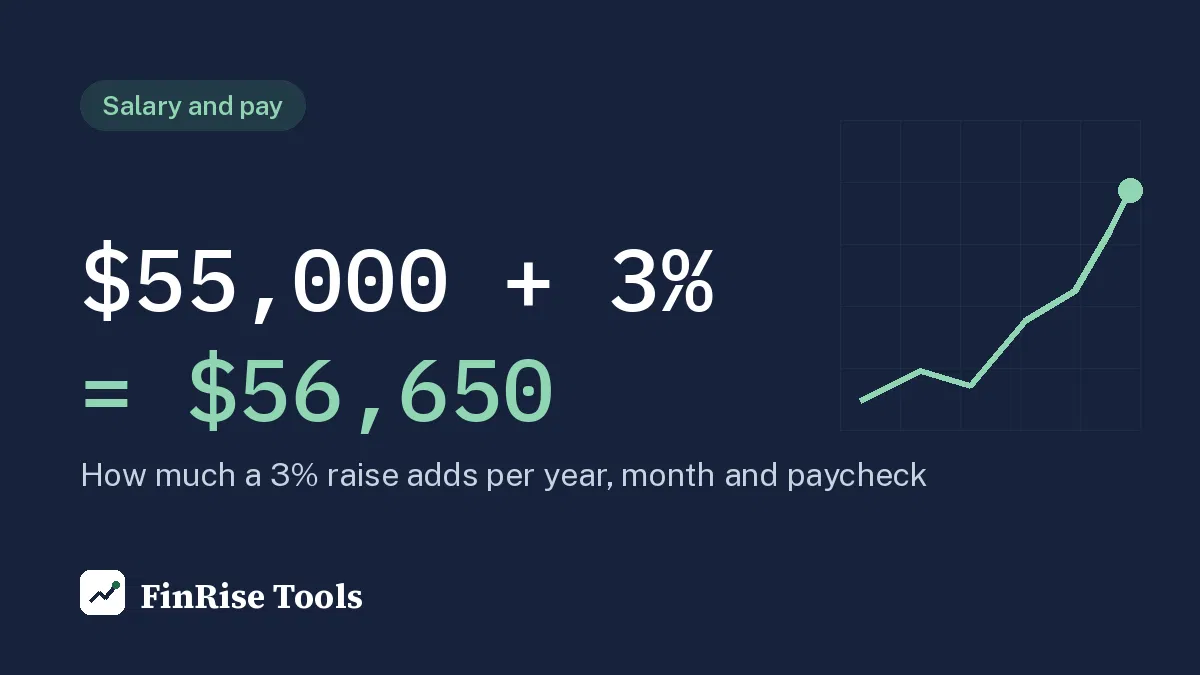
A 3% raise on a $55,000 salary adds $1,650 a year, bringing your pay to $56,650. Here is what that means for each month, each paycheck and your hourly rate, plus a rough idea of how much you keep after taxes.
How the math works
To find a raise, multiply your salary by the raise percentage written as a decimal. Three percent is 0.03.
- Raise amount: $55,000 × 0.03$1,650
- New salary: $55,000 + $1,650$56,650
- Extra per month: $1,650 ÷ 12$137.50
- Extra per biweekly paycheck: $1,650 ÷ 26$63.46
- Extra per week: $1,650 ÷ 52$31.73
If you are paid twice a month instead of every two weeks, you get 24 paychecks a year, so each one grows by $1,650 ÷ 24 = $68.75.
What it means for your hourly rate
A full-time year of 40 hours a week for 52 weeks is 2,080 paid hours. At $55,000, you earn about $26.44 an hour. After the raise, $56,650 ÷ 2,080 works out to about $27.24 an hour, an increase of roughly 79 cents.
If you regularly work more than 40 hours on a salary, your real hourly rate is lower. The Salary to Hourly Calculator shows you the true figure for the hours you actually work.
How much of the raise do you actually keep?
Taxes take a share of every extra dollar. The exact amount depends on your filing status, deductions, benefits and state, but here is a rough example for a single filer who takes the standard deduction and lives in a state with no income tax:
- Social Security and Medicare (7.65%): about $126 of the $1,650
- Federal income tax: at this salary, the extra income for many single filers falls in the 12% federal bracket, so about $198
- Left over: about $1,326 a year, or roughly $51 more in each biweekly paycheck
If your state has an income tax, or you put part of your pay into a 401(k) or health plan, your take-home increase will be different. For an exact number, check your first paycheck after the raise or ask your payroll department.
Other raise amounts on $55,000
How a 2% to 5% raise changes a $55,000 salary, before taxes.
| Raise | Per year | New salary | Per month | Biweekly |
|---|---|---|---|---|
| 2% | +$1,100 | $56,100 | +$91.67 | +$42.31 |
| 3% | +$1,650 | $56,650 | +$137.50 | +$63.46 |
| 4% | +$2,200 | $57,200 | +$183.33 | +$84.62 |
| 5% | +$2,750 | $57,750 | +$229.17 | +$105.77 |
Is a 3% raise keeping up with inflation?
A raise only increases your buying power if it grows faster than prices. A simple check is to subtract the yearly inflation rate from your raise. If prices rose 3% over the past year, a 3% raise keeps you about even. If they rose 2%, you are about 1% ahead.
You can find the latest inflation rate in the Consumer Price Index, published each month by the U.S. Bureau of Labor Statistics.
Frequently asked questions
Is a 3% raise good?
It depends on inflation and on what others in your field are getting. A 3% raise is common for a standard annual increase. Compare it with the current inflation rate and with pay data for your job to see where it stands.
When will I see the raise in my paycheck?
Usually on the first full pay period after the raise takes effect. If the raise starts partway through a pay period, your first check may only include part of the increase.
How do I work out a raise on a different salary?
Multiply your salary by the raise percentage and divide by 100, then add the result to your salary. Or enter your numbers in the Pay Raise Calculator to see the yearly, monthly, paycheck and hourly figures at once.
Try your own numbers
Enter any salary and raise to see your new pay per year, month, paycheck and hour.
Open the Pay Raise CalculatorThis guide is for educational purposes only and is not financial or tax advice. Tax figures are rough estimates for one example situation. Your results will depend on your own circumstances.