
How Much Is a $1 Raise? Per Month, Per Year and After Taxes
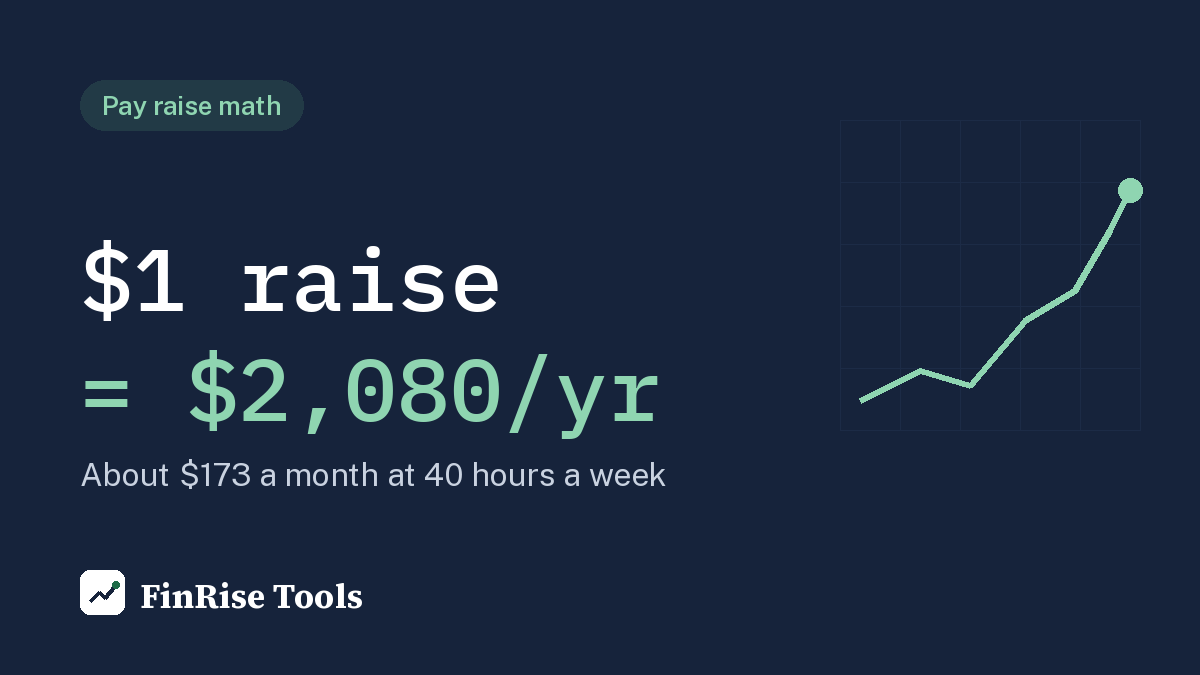
A $1 an hour raise adds $2,080 a year before taxes if you work full time, which is about $173 a month or $80 a paycheck if you are paid every two weeks. This guide shows what a $1 raise is worth in every pay period, what percent raise it is at your wage, how much you keep after taxes and how it compares with a $2, $3 or $5 raise.
The simple math behind a $1 raise
A full-time job in the U.S. is usually counted as 2,080 hours a year: 40 hours a week times 52 weeks. Paid holidays and paid time off are included in that number, because you are paid for those hours too. So every extra dollar per hour is worth:
From there, divide by the number of paychecks you get. Monthly is $2,080 ÷ 12 = $173.33. Biweekly (26 paychecks) is $2,080 ÷ 26 = $80. Weekly is $40. If you are paid twice a month (24 paychecks), it is $86.67 per check.
If you work fewer hours, use your real schedule. At 30 hours a week, a $1 raise adds $30 a week and $1,560 a year. At 20 hours a week, it adds $1,040 a year. Our pay raise calculator does this for any wage, raise and schedule.
What a $1, $2, $3 or $5 raise is worth
Here is what common hourly raises add to your pay before taxes, at 40 hours a week:
| Raise per hour | Per week | Every 2 weeks | Per month | Per year |
|---|---|---|---|---|
| $0.50 | $20 | $40 | $86.67 | $1,040 |
| $1 | $40 | $80 | $173.33 | $2,080 |
| $1.50 | $60 | $120 | $260 | $3,120 |
| $2 | $80 | $160 | $346.67 | $4,160 |
| $3 | $120 | $240 | $520 | $6,240 |
| $5 | $200 | $400 | $866.67 | $10,400 |
A handy shortcut: double the hourly raise and add three zeros to get a rough yearly number. A $2 raise is about $4,000 a year, and a $5 raise is about $10,000. The exact figure is a little higher, because 2,080 hours is slightly more than 2,000.
What percent raise is $1 an hour?
The same $1 means very different things depending on what you earn now. To turn it into a percentage, divide the raise by your current wage and multiply by 100:
| Current wage | New wage | Raise % | Old yearly pay | New yearly pay |
|---|---|---|---|---|
| $12 | $13 | 8.3% | $24,960 | $27,040 |
| $15 | $16 | 6.7% | $31,200 | $33,280 |
| $18 | $19 | 5.6% | $37,440 | $39,520 |
| $20 | $21 | 5.0% | $41,600 | $43,680 |
| $22 | $23 | 4.5% | $45,760 | $47,840 |
| $25 | $26 | 4.0% | $52,000 | $54,080 |
| $30 | $31 | 3.3% | $62,400 | $64,480 |
| $35 | $36 | 2.9% | $72,800 | $74,880 |
At lower wages, $1 is a strong raise. Going from $15 to $16 is a 6.7% increase, larger than many annual merit raises. At $30 an hour or more, $1 is closer to 3%, and once you take rising prices into account, it may only keep your buying power about level. If your employer talks about raises in percentages, the pay raise calculator converts between a percent and a dollar amount in both directions.
How much of a $1 raise you keep after taxes
A raise is taxed at your marginal rate, the rate on your last dollars of income, not your average rate. Every extra dollar also has Social Security (6.2%) and Medicare (1.45%) taken out, which adds up to 7.65%. Here is roughly what you keep from a $2,080 raise:
| Federal tax bracket | Total tax on the raise | You keep per year | You keep per month |
|---|---|---|---|
| 10% | 17.65% | $1,712.88 | $142.74 |
| 12% | 19.65% | $1,671.28 | $139.27 |
| 22% | 29.65% | $1,463.28 | $121.94 |
Most full-time hourly workers fall in the 10% or 12% bracket for 2026. A single filer stays in the 12% bracket until taxable income passes $50,400, after the $16,100 standard deduction. State and local income tax takes a bit more, unless you live in a state with no income tax, such as Texas or Florida.
A raise never lowers your take-home pay. Only the extra dollars are taxed at the higher rate, so moving into a new bracket does not shrink the pay you already had. To see your exact paycheck with a new wage, use the paycheck calculator, or the federal tax calculator for your full-year tax.
Overtime, 401(k) and other ways a raise grows
Overtime. If you are paid hourly and work more than 40 hours a week, federal law requires at least time and a half. A $1 raise lifts your overtime rate by $1.50. Someone who works 5 hours of overtime every week gets an extra $7.50 a week, or $390 a year, on top of the $2,080. The overtime pay calculator shows your full weekly pay.
Your 401(k). If you save a percentage of your pay, your savings grow with your wage. At 6% of pay, a $1 raise adds $124.80 a year to your 401(k), and if your employer matches, that grows again. Over 25 years, small increases like this can add thousands to your retirement balance. Try the numbers in our 401(k) calculator.
Future raises. Percentage raises are figured on your current pay. A $1 bump today makes every future 3% raise a little bigger, so the gain compounds over your career.
Three real-life examples
Maria, retail associate, $16 to $17 an hour, 32 hours a week. Her raise is 6.3%. At 32 hours, she earns $32 more a week, $1,664 more a year and about $139 more a month before taxes. In the 10% bracket she keeps about $1,370 of it, a little over $114 a month, which covers a typical phone and internet bill.
James, warehouse worker, $21 to $22 an hour, 40 hours plus 4 hours of overtime a week. His regular pay rises $40 a week and his overtime rate rises from $31.50 to $33, adding $6 more a week. That is $46 a week in total, or $2,392 a year. The raise is 4.8%, and in the 12% bracket he keeps about $1,922 of it.
Priya, medical coder, $34 to $35 an hour, 40 hours a week. Her raise is only 2.9%, even though it is the same $2,080 a year as everyone else’s full-time raise. In the 22% bracket she keeps about $1,463. At her pay level, a percentage raise of 3% or more would be worth more than a flat $1, so she plans to compare offers before her next review.
Is a $1 raise good? How to judge any raise
Ask three questions:
- What percent is it? Divide the raise by your wage. Under about 3% often means you are only keeping pace with higher prices.
- What does the market pay? Compare your new wage with job postings for the same role in your area. If others pay $2 to $3 more, a $1 raise may not be enough.
- What else comes with it? More paid time off, better health insurance, a higher 401(k) match or a more predictable schedule can be worth more than a bigger hourly raise.
If you are weighing a raise against a salaried job, the hourly to salary calculator and our guide on hourly vs. salary help you compare the two fairly.
How to ask for a raise
If a $1 raise is not what you hoped for, it is reasonable to ask for more. A few steps that work:
- Bring numbers. Note what you have done: extra shifts covered, new skills, training others, sales or customer praise.
- Know your market rate. Look at current job postings for similar roles nearby, and name a specific wage, such as “$22 an hour,” not a vague “more.”
- Pick the right time. Ask before budgets are set, after a strong review or when you take on new duties.
- Have a fallback. If the answer is no, ask what you would need to do to earn it, and agree on a date to revisit.
Frequently asked questions
How much is a $1 raise per year?
A $1 an hour raise is worth $2,080 a year before taxes if you work 40 hours a week for 52 weeks. That is $40 a week, $80 every two weeks and about $173 a month. Part-time at 30 hours a week, it adds $1,560 a year.
How much is a $1 raise per month?
About $173.33 a month before taxes for a full-time, 40-hour week ($2,080 a year divided by 12). After federal income tax and payroll taxes, most people keep roughly $120 to $140 of it each month.
What percent raise is $1 an hour?
Divide $1 by your current hourly wage. At $20 an hour, $1 is a 5% raise. At $15 it is 6.7%, at $25 it is 4% and at $30 it is 3.3%. The lower your wage, the bigger the percentage.
Is a $1 raise good?
It depends on your current pay. At $15 to $20 an hour, a $1 raise is 5% to 6.7%, which beats many typical annual raises. At $35 an hour or more it is under 3%, which may barely keep up with rising prices.
How much is a $2 raise per year?
A $2 an hour raise adds $4,160 a year before taxes at 40 hours a week, or $346.67 a month and $160 every two weeks. At $20 an hour, that is a 10% raise.
How much of a $1 raise do I keep after taxes?
In the 12% federal bracket you pay about 19.65% in federal income tax plus Social Security and Medicare, so you keep about $1,671 of a $2,080 raise. In the 22% bracket you keep about $1,463. State income tax lowers that further, except in states with no income tax.
See what your raise is really worth
Enter your current wage and your raise in dollars or percent to see your new pay per hour, paycheck, month and year.
Open the Pay Raise CalculatorSources
The 2026 tax brackets and standard deduction are from IRS Revenue Procedure 2025-32. Social Security and Medicare tax rates are from the IRS Topic 751. Overtime rules are from the U.S. Department of Labor’s overtime pay page. All pay and tax figures in the tables are our own calculations.
This guide is for educational purposes only and is not tax or financial advice. Take-home amounts are estimates that leave out state and local taxes and pre-tax deductions such as health insurance, which vary by person.