
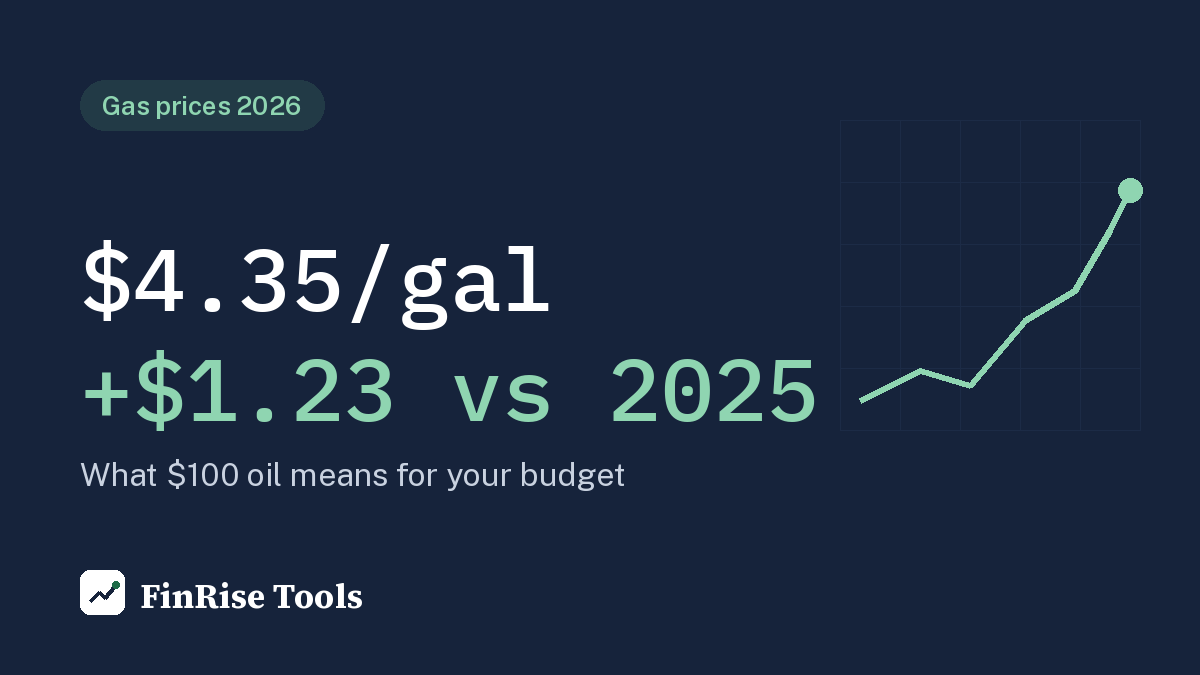
Gas Prices Above $4 in 2026: What $100 Oil Means for Your Budget
Oil prices have jumped in 2026, and you are feeling it at the pump. The U.S. average for regular gasoline was $4.35 a gallon on October 5, 2026, about $1.23 more than a year ago, and Brent crude traded near $101 a barrel. This guide explains why prices are high, how much more the average driver is paying, how oil reaches your mortgage and credit card rates, and practical ways to protect your budget.
Why gas prices are so high right now
About half of what you pay for a gallon of gasoline is the cost of crude oil. The EIA estimates crude makes up roughly 52% of the retail gasoline price and 42% of diesel; the rest is refining, distribution, marketing and taxes. So when oil jumps, the pump follows within days or weeks.
In 2026, conflict in the Middle East has constrained oil flows from the region, one of the world’s most important sources of crude. Attacks on Saudi Arabia’s East-West pipeline added to fears about supply. Brent crude, the global benchmark, was about 54% higher on October 6 than a year earlier. U.S. gasoline averaged $4.35 and diesel $6.29 in September, both sharply higher than in August, according to the EIA’s October Short-Term Energy Outlook.
Prices also vary a lot by where you live. In the first week of October, regular gasoline averaged about $3.91 on the Gulf Coast but $5.73 on the West Coast, and California was the most expensive state at about $6.23.
How much more you are paying for gas
Your extra cost depends on how far you drive and how efficient your car is. Here is the yearly gas bill for 12,000 miles a year, comparing about $3.12 a gallon a year ago with $4.35 now:
| Fuel economy | Gallons a year | At $3.12 | At $4.35 | Extra per year | Extra per month |
|---|---|---|---|---|---|
| 20 mpg | 600 | $1,874 | $2,612 | +$738 | +$62 |
| 25 mpg | 480 | $1,500 | $2,090 | +$590 | +$49 |
| 30 mpg | 400 | $1,250 | $1,742 | +$492 | +$41 |
| 40 mpg | 300 | $937 | $1,306 | +$369 | +$31 |
And for 15,000 miles a year, closer to a long daily commute:
| Fuel economy | Gallons a year | At $3.12 | At $4.35 | Extra per year | Extra per month |
|---|---|---|---|---|---|
| 20 mpg | 750 | $2,343 | $3,266 | +$922 | +$77 |
| 25 mpg | 600 | $1,874 | $2,612 | +$738 | +$62 |
| 30 mpg | 500 | $1,562 | $2,177 | +$615 | +$51 |
| 40 mpg | 375 | $1,172 | $1,633 | +$461 | +$38 |
To find your own number: yearly miles ÷ your mpg × $1.23, or enter your miles, mpg and local price in our gas cost calculator. A two-car household can easily be paying $1,000 to $1,500 more a year than in 2025, without driving a single extra mile. Our paycheck calculator shows what that is as a share of your take-home pay.
Beyond the pump: how $100 oil reaches the rest of your budget
Groceries and goods. Diesel powers the trucks, trains and farm equipment that move almost everything you buy. With diesel up about $2.49 a gallon from a year ago, shipping costs rise, and some of that shows up in prices at the store over the following months.
Travel. Jet fuel follows crude oil, so airfares for the holidays are likely to be higher than last year. Booking early and staying flexible on dates helps.
Interest rates. Higher energy prices push inflation up, and inflation keeps interest rates high. The Federal Reserve raised its target range to 3.75%–4.00% on September 16, the 10-year Treasury yield reached about 5.33% on October 1 and the average 30-year mortgage rate was 7.03% on September 24. Our guide on rising bond yields explains what that means for mortgages, credit cards and savings.
Heating. There is some good news here. The EIA expects households that heat with natural gas or propane to spend less on those fuels this winter than last. Homes that use heating oil, which is made from crude, are more exposed to the oil price spike.
8 ways to protect your budget from high gas prices
- Compare prices before you fill up. Prices can differ by 30 cents or more a gallon within a few miles. Gas price apps and warehouse clubs are often cheapest.
- Use a gas rewards card, only if you pay in full. 3% to 5% back on fuel helps, but carrying a balance at 20%+ APR wipes out the savings.
- Drive smoother and slower. Hard acceleration and highway speeds above about 50 mph burn noticeably more fuel. Cruise control on the highway helps.
- Check your tire pressure and lighten the load. Underinflated tires and extra weight in the trunk lower your mileage.
- Combine errands and share rides. Several short trips from a cold start use more fuel than one planned loop. Carpooling once or twice a week cuts commute costs directly.
- Raise the fuel line in your budget. Plan for today’s prices, not last year’s, so the extra cost doesn’t end up on a credit card. Our savings goal calculator shows how much to set aside each month.
- Keep your emergency fund topped up. Energy shocks often come with layoffs and price jumps elsewhere. Check how much you should have with the emergency fund calculator.
- Pay down variable-rate debt. With rates high, credit card interest grows fast. The credit card payoff calculator shows how much faster you can be debt-free with a bigger payment.
One upside of high rates: cash earns more. If you have savings sitting in a low-rate account, compare today’s CD and Treasury bill rates with our CD calculator and Treasury bill calculator.
Will gas prices come down?
The EIA’s October outlook expects oil to stay expensive for the rest of 2026, with Brent averaging about $105 a barrel in the fourth quarter, $14 higher than it forecast a month earlier. It then expects prices to ease, with U.S. gasoline averaging just under $3.60 a gallon in 2027 and Brent around $84.
Those forecasts assume oil flows from the Middle East stay constrained through the end of 2026. A ceasefire or reopening of supply routes could bring prices down faster; new attacks on oil facilities could push them higher. Nobody can time this reliably, so the safest plan is to budget for today’s prices and treat any drop as a bonus.
Frequently asked questions
Why are gas prices so high in October 2026?
Mainly because crude oil is expensive. Conflict in the Middle East has constrained oil flows from the region, and attacks on Saudi Arabia's East-West pipeline added to supply worries. Brent crude traded near $101 a barrel on October 6, 2026, about 54% higher than a year earlier, and crude oil makes up roughly half of what you pay for gasoline.
What is the average gas price in the U.S. right now?
The EIA's national average for regular gasoline was $4.354 a gallon on October 5, 2026, down 11 cents from the week before but about $1.23 higher than a year earlier. Diesel averaged $6.199. California was the most expensive state at about $6.23 for regular.
Will gas prices go down?
The EIA expects some relief, but not right away. In its October 2026 outlook it forecasts Brent crude averaging about $105 a barrel in the last three months of 2026 and U.S. gasoline averaging just under $3.60 a gallon in 2027. Those forecasts assume Middle East supply stays constrained through the end of 2026 and could change quickly.
How much more am I paying for gas than last year?
At about $1.23 more per gallon, someone who drives 12,000 miles a year in a car that gets 25 mpg uses about 480 gallons and pays about $590 more a year, or roughly $49 a month. Divide your yearly miles by your mpg and multiply by $1.23 for your own number.
Do high oil prices affect mortgage and loan rates?
They can. Higher fuel prices push inflation up, which can keep the Federal Reserve from cutting rates and push bond yields higher. The Fed raised its target range to 3.75% to 4.00% in September 2026, and the average 30-year mortgage rate was 7.03% on September 24.
See what gas really costs you
Enter your miles, your car’s mpg and your local gas price to see your monthly fuel bill and how much this year’s price jump adds.
Open the Gas Cost CalculatorSources
Weekly gasoline and diesel prices, regional prices and the share of crude oil in pump prices are from the U.S. Energy Information Administration’s Gasoline and Diesel Fuel Update for October 5, 2026. September averages, Middle East supply conditions, the East-West pipeline attacks and the price forecasts are from the EIA’s October 2026 Short-Term Energy Outlook. The Brent price is from Fortune’s October 6, 2026 oil price report. The federal funds range is from the Federal Reserve. Gas cost tables are our own calculations.
This guide is for general information only and is not financial advice. Fuel prices change daily and vary by location. Forecasts are the EIA’s and may change as events unfold.